Knowledge optimizer overview
Series: Knowledge optimizer for the knowledge workbench
Next suggested step: Knowledge optimizer dashboard
Knowledge optimizer is a tool that enables you to optimize, or improve your knowledge base and knowledge configuration content. The knowledge optimizer provides insights about possible gaps in your knowledge setup and areas for improvement.
To view the knowledge optimizer dashboard, click Admin > Knowledge > Optimizer.
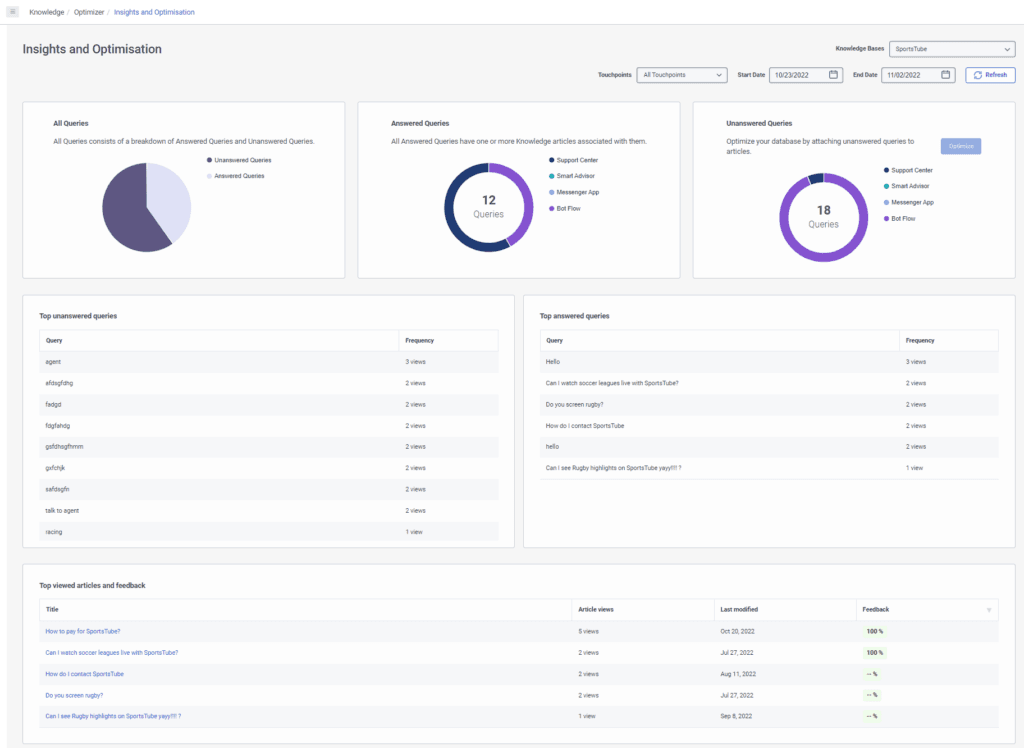

Knowledge base V2
- All queries in a specific time frame and the breakdown, in percentages, of answered and unanswered queries.
- All answered queries in a specific time frame and the breakdown, in percentages, of the application from which the answered queries originated. These applications are Knowledge Portal, Knowledge app for Messenger, Genesys Dialog Engine Bot Flow, Genesys Digital Bot Flow, and Agent Assist.
- All unanswered queries in a specific time frame and the breakdown, in percentages, of the application from which the unanswered queries originated.
- These applications are Knowledge Portal, Knowledge app for Messenger, Genesys Dialog Engine Bot Flow, Genesys Digital Bot Flow, and Agent Assist.
- Top 50 articles, the frequency in which an article appeared in a conversation, and its feedback score, including positive and negative feedback counts.
- Top 20 answered queries and the frequency in which each answered query appeared in a conversation.
- Top 20 unanswered queries and the frequency in which each unanswered query appeared in a conversation.
Understand popularity in knowledge base articles
The Hits column of a metric displays the number of times the customer asked a question with the same intent on the touchpoint. These questions with similar intent are grouped to provide insight about the current “hot topics.”
The number in the Hits column is not the total number of hits for a particular query or article, but the number of hits since a task related to the query or article was last completed in the knowledge optimizer. This view enables you to see tasks that need your attention based on recent traffic, as opposed to total traffic. Best practice recommends that you clear all tasks from the knowledge optimizer, and let the traffic insert tasks from scratch.
Optimize unanswered queries
For unanswered queries, you can optimize the content. When you select to optimize unanswered queries, you can do the following:
- See the details of a query. For example, the number of article hits, the number hits for the top 20 queries, the number of hits for the top 20 answered queries, and the number of hits for the top 20 unanswered queries.
- See a list of suggested related articles that might contain the answer to an unanswered query.
- Associate an existing article of your choice for an unanswered query.
- Create a new article for the unanswered query, in case no matching answer exists in the knowledge base.
- Add phrases to a new article.
- Add phrases to an existing article as is or after editing it.
The server processes the data once per day, so it can take up to 24 hours before you can optimize unanswered queries.
View details and feedback about the top articles
The top surfaced articles tile displays details about the most popular trending articles, up to 50, used in the knowledge base for a specified time frame. The tile also displays the number of times each article was used in bot conversations, the last modified date, and the percentage of positive or negative feedback, including positive and negative feedback counts. When you click one of the articles, you can view the following information:
The article view displays the following information:
- The query and answer
- Article details such as the knowledge base, language, date created, date last modified, author, and status
- Analytics such as number of positive feedback hits and number of negative feedback hits
- Other queries that this article answered
With these details, you can review and determine if you should make changes on articles in the knowledge base.
Knowledge configuration
You can view these metrics for knowledge configurations:
- The total number of interactions in which the selected touchpoints generated answers from knowledge fabric content during the selected date range.
- The total number of feedback submissions, both positive and negative, that touchpoints received on generated answers within the selected date range.
- The count of answer generation queries that received negative feedback, indicating instances where the generated answer did not adequately address the query.
The Knowledge Optimizer dashboard provides administrators with three key metrics to monitor and improve knowledge fabric performance. The Total interactions tile shows the volume of voice and digital interactions where selected touchpoints generated answers from knowledge fabric content, giving administrators a baseline for overall usage. The Total feedback tile displays the total positive and negative feedback submissions received on generated answers, helping administrators gauge engagement with the feedback mechanism and interpret feedback scores with the right context. The Queries with negative feedback section lists up to 50 answer generation queries that received negative feedback, allowing administrators to drill into specific queries, review details such as generated answers, sources, and touchpoints, and identify knowledge gaps or content issues that need attention.
Currently, the dashboard shows metrics for the touchpoints configured for Agent Copilot.
View details of a query with negative feedback
Using the Query details panel, you can view more details such as queried date, suggestion, whether copied by agent or not, whether context search was enabled, and the conversation ID. It also shows the generated answer and sources that were used to generate the answer.
[NEXT] Was this article helpful?
Get user feedback about articles.